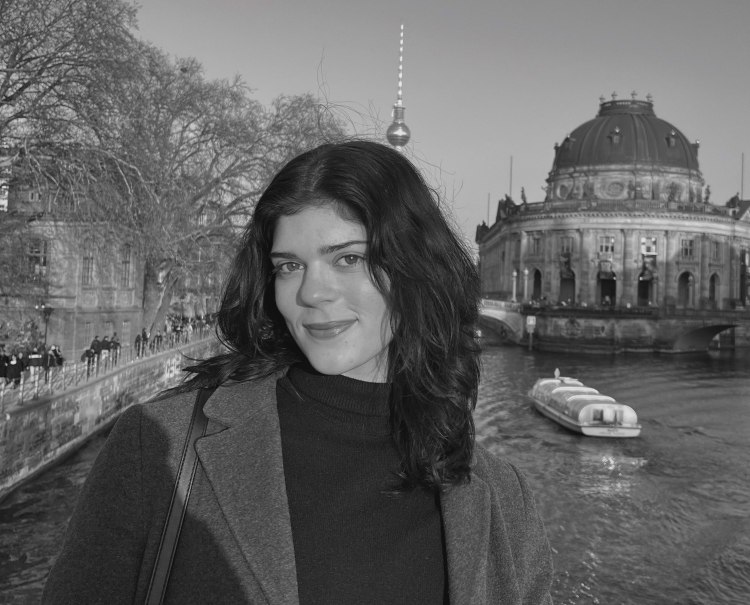
Milagros Fernández Solís es estudiante del último curso del Grado en Filología Inglesa de la Universidad de Salamanca, donde realiza su Trabajo de Fin de Grado sobre The Waste Land, de T.S. Eliot. Entre sus intereses se encuentra el género fantástico y la representación de las emociones en el lenguaje poético. En particular, se ha centrado en la emoción y experiencia del deseo en la poesía de Coral Bracho, atendiendo a la voz, la respiración y el ritmo desde una perspectiva fenomenológica. También ha estudiado la noción de gesto en la obra de Aracelis Girmay en perspectiva cognitiva. Gracias al Programa Erasmus cursó un año de estudios en la Universidad de Galway y ha colaborado como auxiliar de edición en el volumen Dimensiones teóricasde la lírica (2026). Actualmente disfruta de una Beca de colaboración en el Área de Teoría de la Literatura y Literatura Comparada para desarrollar el proyecto «Poéticas de la ausencia: estudio cognitivo-literario del deseo y la desolación en la obra de Chantal Maillard y Louise Glück», a la vez que incursiona en la ficción especulativa de Ursula K. Le Guin.
Milagros Fernández Solís is a last year student of the Degree in English Studes at the University of Salamanca, where she is currently developing her Bachelor thesis on T. S. Eliot’s The Waste Land. Her research interests include the fantasy genre and the representation of emotions in poetic language. In particular, she has focused on the emotion and experience of desire in the work of Coral Bracho, paying attention to voice, breath and rhythm from a phenomenological perspective. She has also studied the notion of gesture in the work of Aracelis Girmay from a cognitive perspective. Thanks to the Erasmus program, she spent a year studying at the University of Galway, and she has collaborated as assistant editor in the volume Dimensiones teóricas de la lírica (2025). She currently enjoys a scholarship in the area of Literary Theory and Comparative Literature to develop the project ‘Poetics of absence: cognitive-literary study of desire and desolation in the work of Chantal Maillard and Louise Glück’, while she also explores Ursula K. Le Guin’s speculative fiction.
 COPOS
COPOS 